Maison du Quantique Grand-Est
  • Homepage
  • What about us
    • What is Quantum?
    • MaQuEst
    • Our network
  • Innovation
    • Funding programme
    • Training programmes
    • Find the expertise you need
  • Our news
    • Latest news
    • Subscribe to our newsletter
    • Contact us

Select your language

  • English (United Kingdom)
  • French (fr-FR)

MaQuEst is seeking a project manager with expertise in quantum computing

10 November 2026

The University of Reims Champagne-Ardenne (URCA) is seeking an expert to develop hybrid computing, combining quantum computing and high-performance computing (HPC), within the Maison du Quantique MaQuEst.


A state-of-the-art environment

For the past 25 years, URCA, through the ROMEO Computing Centre and the LICIIS laboratory, has been a major player in high-performance computing and numerical simulation. It has a quantum emulator and already runs training courses in this field. As a partner in the regional MaQuEst project, it will host the expert recruited to strengthen its hybrid computing activities.


Vos missions

  1. Piloter les actions de calcul quantique du LICIIS/ROMEO
  2. Animer et développer des projets, ainsi que les réseaux régionaux et nationaux
  3. Concevoir et diffuser des formations et des événements (workshops, hackathons…)
  4. Accompagner les entreprises : prospection, montage de projets, cas d’usage
  5. Développer des solutions logicielles reliant cluster HPC, émulateur et plateforme quantique
  6. Superviser le projet MaQuEst : coordination, livrables, reporting


Your profile

Expertise in quantum computing and HPC
Proficiency in frameworks (MyQLM, Qiskit, Cirq, etc.) and programming languages (Python, C++, etc.)
Teaching skills, strong writing abilities and the ability to synthesise information
Independence, good listening skills and the ability to work in a team
Advanced English
Good knowledge of academic and industrial networks

Terms and conditions

  1. Position: Category A, full-time
  2. Contract: One-year fixed-term contract, to start as soon as possible, renewable until March 2028

  3. Salary: commensurate with experience

  4. Location: Moulin de la Housse campus (Reims), with weekly attendance at Sup Ardenne (Charleville-Mézières) and occasional travel to Nancy and Strasbourg

Apply by 4 December 2026
Full details are available here.

Quantum Industry Matchmaking: MaQuEst’s takeaways from the event on 19 October

Quantum Industry Matchmaking: MaQuEst’s takeaways from the event on 19 October

27 October 2026

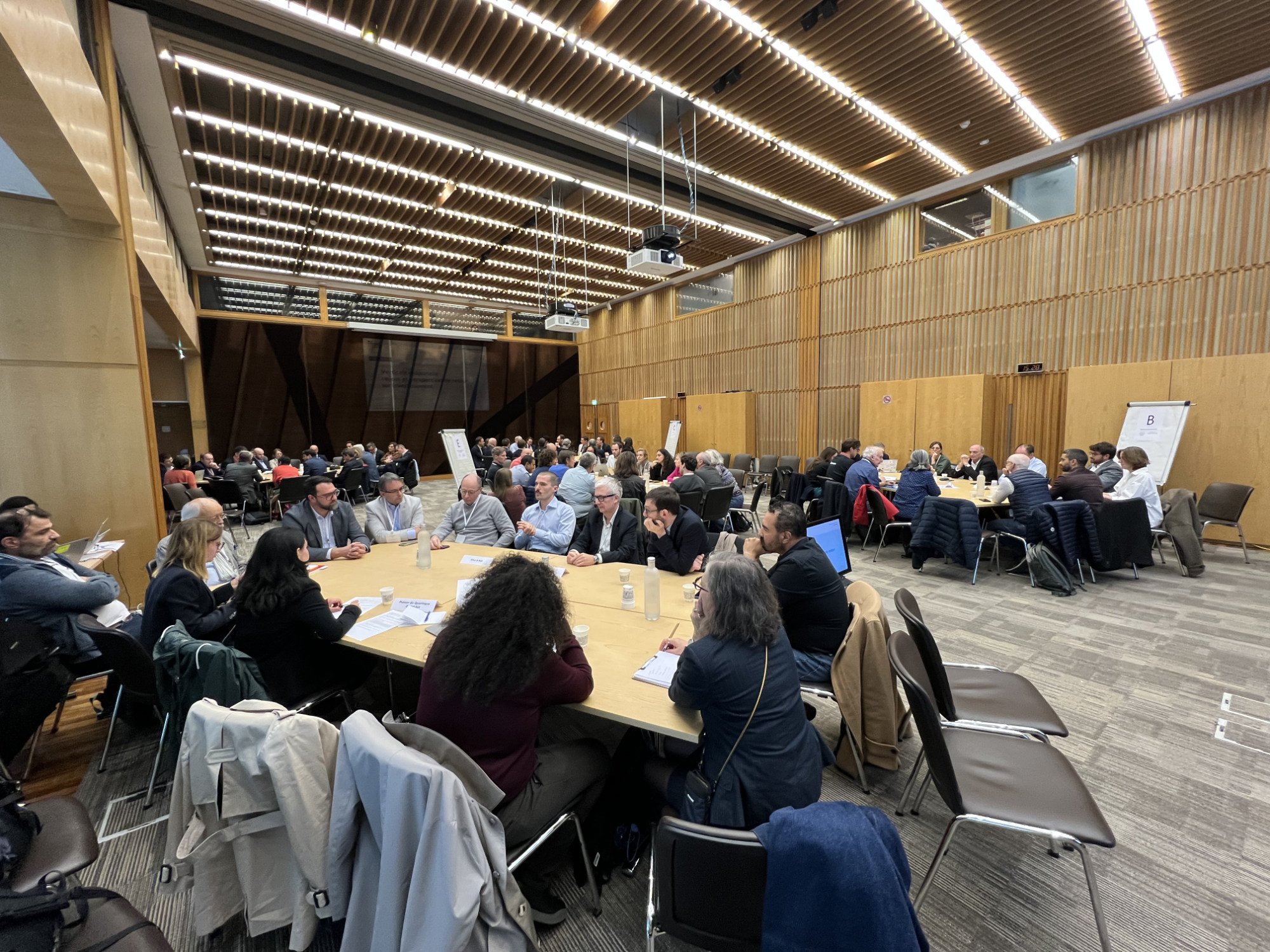
On 19 October in Paris, more than 80 decision-makers, scientists and quantum specialists gathered at an event organised by the French Directorate-General for Enterprise and the CSF “Trusted Software and Digital Solutions”. Throughout the day, the specialists exchanged views on the topic of innovation through quantum and hybrid computing. The MaQuEst team took part and is sharing its key takeaways here.


A day dedicated to gaining a better understanding of innovation through quantum computing

The aim of the event was to help shape the sector by promoting the sharing of knowledge and best practice, and by bringing together complementary stakeholders. The programme was structured around three objectives:

  1. to gain a better understanding of the French quantum computing ecosystem;
  2. to identify the challenges where it can deliver real added value;
  3. to discover how to access quantum computing infrastructures and their services.

To address these questions, the event brought together a diverse range of participants: decision-makers, scientists and quantum specialists, including industry players such as Alice & Bob, manufacturers such as Servier France, and representatives from several ‘Maisons du Quantique’ from other regions. Thematic round-table discussions organised by sector facilitated more focused exchanges, including one dedicated to the chemical and pharmaceutical industries, which was moderated by MaQuEst.


Chemistry and pharmaceuticals: three key takeaways

Alongside Alice & Bob and Servier France, MaQuEst led the roundtable discussion dedicated to the chemical and pharmaceutical industries. From these discussions, we have identified three key takeaways.

  1. Computing power is a limiting factor for these industries. Many challenges are constrained by current computing capabilities. In this context, even a modest improvement can represent a significant gain.
  2. This is a long-term investment. Companies in the sector are currently in a preparatory phase, looking ahead to future applications.
  3. This preparation is already bearing fruit. By rethinking a problem to adapt it to quantum computing, some are discovering new, more efficient ways of tackling it using classical computing.


Practical exchanges between participants

The day was a resounding success. Many discussions centred on sharing best practice, to better understand this technology and explore its use cases. This type of event enables us to collectively identify what needs to be done in the near future to benefit from these technologies. We believe this is essential, and we are already keen to take part in future events.


Businesses in the Grand Est region: the MaQuEst call for projects is open

Are you a business based in the Grand Est region looking to explore quantum computing? The MaQuEst call for projects is open until 16 November. Full details can be found here.

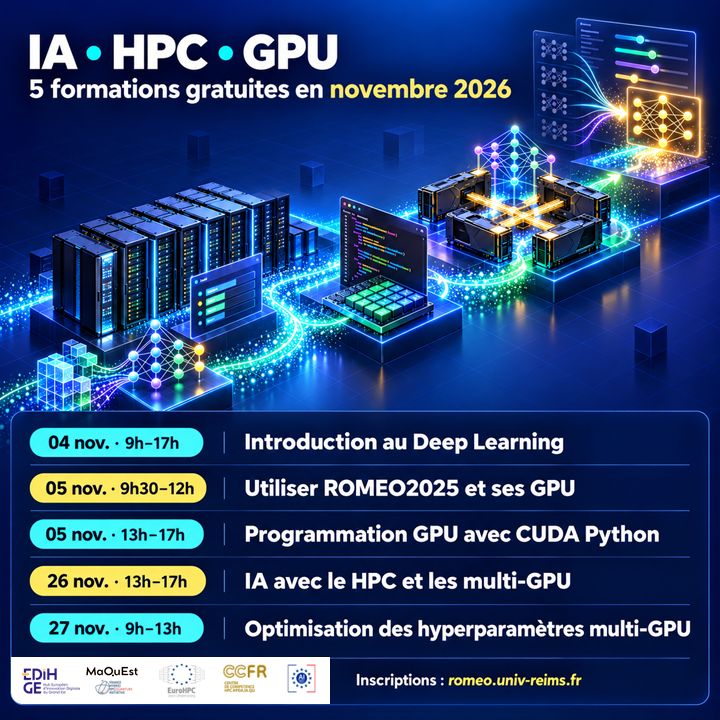
From your first job working on a supercomputer to multi-GPU AI: 5 free training courses in November in Reims or online

From your first job working on a supercomputer to multi-GPU AI: 5 free training courses in November in Reims or online

19 October 2026

Our partner, the University of Reims Champagne-Ardenne (URCA), is offering, via its ROMEO computing centre, a series of five free training courses on GPU computing and artificial intelligence between 4 and 27 November 2026. All practical exercises are carried out directly on the GPUs of the ROMEO2025 supercomputer.

Practical information

  • Target audience: researchers, engineers, students and developers from both academia and industry.
  • Prerequisites: each session can be taken individually, depending on your level. However, the series as a whole forms a comprehensive programme: you’ll learn the basics, get to grips with the tool, then move on to speeding up and optimising your code.
  • Venue: URCA, Moulin de la Housse Campus, Reims.
  • Fee: free of charge, but places are limited. We recommend registering as soon as possible, either for individual sessions or for the entire course.

A framework of European and regional projects

These training courses are offered as part of the EDIH GE (Grand Est), GENI (Grand Est Numérique Intensif), MesoNET, EuroHPC Joint Undertaking (EuroHPC JU), AI Factory France and CC-FR projects.


To find out more about the programme, visit the dedicated page: https://romeo.univ-reims.fr/


Our webinar on identifying use cases for quantum computing is now available online!

Our webinar on identifying use cases for quantum computing is now available online!

12 October 2026

During a webinar organized by MaQuEst on October 16, 2026, our team engaged in a discussion with representatives from Scaleway, QbitSoft, and QPerfect about methods for identifying use cases for quantum computing within their companies. Together, Lesya Dymyd, Valentin Macheret, Lionel Rigaud, and Aymane Hassani discussed the steps to follow, the sectors where quantum computing appears to be relevant for implementation, presented examples, and outlined the support available to companies in the Grand Est region.


Watch the webinar on strategies for identifying use cases for quantum computing

https://www.youtube.com/watch?v=YNhHAZEGaTQ


How can MaQuEst help you identify your quantum computing use cases today?

MaQuEst, the Grand Est region’s quantum hub, is dedicated to supporting you in this exploration. We help you reduce costs and connect with the right partners in the Grand Est region. Take the first step with our call for projects, open through November 16. Two funding options are available:

  1. Option 1 - Quantum Assessment: Identify and explore your use cases with funding of up to €15,000 (20% to 50% of expenses, depending on the size of your company).
  2. Option 2 – Quantum R&D and Innovation Project: Develop an innovative use case applied to a specific industrial challenge, with funding of up to €150,000 (25% to 45% of expenses, depending on the size of your company).

Don’t wait any longer, contact us to learn more: This email address is being protected from spambots. You need JavaScript enabled to view it.

Exploring quantum computing use cases: how to start?
credits: Nicolas Busser

Exploring quantum computing use cases: how to start?

08 October 2026

Quantum computing offers new approaches to computing, where we compute with probabilities rather than certainties. This fundamental changes allows us to answer problems that are difficult for classical computing. Now, to actually benefit from this technology, the challenge is to find the areas where this provide relevant and tangible advantage. It is time to identify use cases.

The first step : start with the problems

The idea is not to start from the tool and look for problems where it could be used. In order to bring real value, the first step is to identify current problems where there is a benefit from having them better dealt with. Only then, asking ourselves if a problem can be treated better with a quantum computer becomes relevant.

What does an appropriate problem for quantum computing look like?

First, not every computational task needs a quantum computer. When estimating if a task can be tackled with quantum computing, one could identify that it’s only relevant for a specific segment. In that case, combining a classical and a quantum computing approach, an hybrid one, might be a way to benefit from what they each do best.

Though, the nature of some problems is more adapted to what quantum computing could solve efficiently. Here are some examples where this technology is expected to show the most potential :

  1. Too many combinations to test one by one through classical computing
  2. Too many interacting components to model together
  3. Too many possible scenarios to evaluate
  4. A complex data structure that classical methods could struggle to handle.

Such problems appears in many fields: chemistry, insurance, finance, health... and take familiar form such as optimisation, simulation or machine learning. Howewer, no map can tell you whether quantum computing is relevant to your organisation. That depends on your whole business context, and the best way to find out is to start exploring quantum computing yourself.

What can you do tomorrow?

To identify your use cases, we recommend you to follow these four steps : identify, qualify, benchmark and decide.

  1. Identify a few computation intensive problems in your business, with relevant key performance indicators to improve
  2. Qualify the problem, if it one where quantum computing might be relevant
  3. Benchmark the results and potential for improvment based on the established KPI
  4. Decide whether to explore further this particular problem

A tip that our partners shared is to start with the problem that maximises learning, not necessarily your biggest or most blocking issue. A well-chosen first case will teach your teams more and faster than a high-stakes one.

How can MaQuEst help you today

MaQuEst, the quantum hub of the Grand Est region, exists to support you in this exploration. We help recude its cost and connect you with suitable partners in the Grand Est. Take your first step with our call for projects, which is open until November 16. Two funding options are available:

  1. Option 1 – Quantum Assessment: Identify and explore your use cases with funding of up to €15,000 (20% to 50% of expenses, depending on the size of your company).
  2. Option 2 – Quantum R&D and Innovation Project Develop an innovative use case applied to a specific industrial challenge, with funding of up to €150,000 (25% to 45% of expenses, depending on the size of your company).

Don’t wait and contact us to know more This email address is being protected from spambots. You need JavaScript enabled to view it. 

  1. MaQuEst call for proposals, designed to support your quantum and hybrid innovation projects, is now open!
  2. quantum computing for health sector: why should you look for applications now?
  3. “Quantum: Understand to Innovate”, a webinar to help you understand the impact on your business
  4. Webinar: MaQuEst and three companies provide you with the keys to identifying your use cases for quantum computing

Page 1 of 2

  • 1
  • 2
© 2026 CESQ. Designed by E-NOVEA
  • Legal information
  • Privacy Policy
  • Administration
Maison du Quantique Grand-Est
  • Homepage
  • What about us
    • What is Quantum?
    • MaQuEst
    • Our network
  • Innovation
    • Funding programme
    • Training programmes
    • Find the expertise you need
  • Our news
    • Latest news
    • Subscribe to our newsletter
    • Contact us
  • contact@maquest.fr